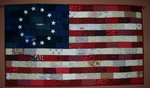
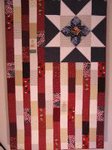
I added a border to the Snail's Tail quilt top posted earlier this year (see here). It is now 60 in square. I will be sending it to the Quilts of Valor Foundation to be used for a wounded soldier. It is interesting how a border can change a quilt. I think it looks much better with the simple border than without. It is machine pieced and machine quilted.
Friday, February 29, 2008
Thursday, February 28, 2008
University of Arkansas Physics Centennial
Updated 3/2017-- photos and all links removed as many are no longer active and it's easier than checking each one.
I am more excited than I should be to be attending the 100th Year of Physics at the University of Arkansas in early April. I finally got someone to trade unassigned ER call weeks with me so that I can go. That's right I am a physics nerd, as my kid sister (now 46 yo) would say. I graduated with a BA Physics degree from U of A in 1978. I am look forward to visiting with the professors and fellow graduates.
I will get to hear Dr. Wolfgang Ketterle give the Centennial Maurer Distinguished Lecture. The title of the lecture is "New Forms of Quantum Matter Near Absolute Zero temperature". I hope I won't feel too lost. I have not kept up with the changes in Physics. (We all know it's tough enough keeping up with the changes in medicine.)
I have made my hotel arrangements, made arrangements for Rusty (my chocolate Labrador), and am mentally packing.
Wednesday, February 27, 2008
"My Worst Nightmare"
Updated 3/2017-- photos and all links removed as many are no longer active and it's easier than checking each one.
Recently I have had to deal with a patient who refers to herself as my "worst nightmare". I knew she would be difficult before I ever did her surgery. She had warned me that she always had a lot of pain and it was difficult to control. I knew she would need more TLC than most patients.
I always call outpatients the night of surgery. It helps me sleep better and hopefully them/their families too. The night of her surgery (and I have learned to double check phone numbers where they will be), I called three separate times over a 2 hour period to two numbers. No one answered any of them. I left a message that "If there are any problems tonight, please, have me paged through the Medical Exchange at ****. I will check on you again in the morning." That night it was quiet.
I called her the next morning and this time she answered."I'm in so much pain."
After going through a list of questions to make sure there were no other issues (no undue swelling, no fever, etc), "Have you tried taking the Xanax with the Percocet?"
"No. I didn't know I could do that."
I had written the Xanax prescription after seeing how she dealt with the pain in the recovery room. Nothing we tried had seemed to make her comfortable until we tried it. I mean nothing including morphine. And physically she appeared okay.
I explained that she could. That the Xanax would help her nerves and help her rest. "So why don't you try that. I'll call you again tonight." She agreed.
I called back that night (Friday). Things seemed to be better. Saturday was quiet. Sunday, just past noon, the pager goes off. I called the number.
"Dr. Bates, it's your worst nightmare. The pain is horrible and I don't have any pain medicine left."
I go through the same list. No undue swelling, no fever, etc. So I offer to call in some Darvocet (and do so). I don't offer to meet her and write a new script for the Percocet. I don't suggest that she go to the ER. Two hours later, the pager goes off again. Same patient.
"Dr. Bates, I'm so sorry. It's your worst nightmare again. I don't know what to do. The pain is so bad."
This time I firmly tell her that she will have to tough it out until tomorrow (Monday) as I can't phone anything stronger in for her. She will have to make due with the Darvocet. (By my count, the Percocet should have lasted her until Monday or Tuesday).
Nothing more from her until first thing Monday morning when she calls the office. "Dr. Bates, it's your worst nightmare. I am in so much pain."
"You are no where near my worst nightmare, but we won't go there. Why don't you come into the office so I can see you. You will have to come into the office before I give you anything more for pain."
She comes in. Her exam is benign. She is healing as expected. I touch the operative area gently--she flinches. I leave it and keep talking to her. She visibly relaxes, as the time passes. I keep up a constant patter. I remove her stitches and tape the incision. I deliberately touch the area again with slightly more pressure. This time there is less flinching. I keep talking to her. Then one more time palpate the area. This time pointing out how she allows me to do so.
I give her one more script for Percocet and Xanax. I caution her to take them as prescribed, not more often. I bring up the young actor, Heath Ledger, who recently "overdosed" on prescription medications. She says she didn't realize you could take too many. She did fine from that visit on.
So for her I think that much of her pain was in her head. I think she "thought" she hurt more than she "actually physically" did. I don't mean to belittle her pain, but she had had a few bad experiences with pain, so she ANTICIPATED that each new event would be as bad or worst. I think that "fear" adds to her pain.
I try to get patients to realize that there will be pain, but that each day will get a little better. I don't try to make "light" of it, but to get them to distract themselves. Or to "reassure" themselves that it is not a permanent state. Postoperative pain (I know there are exceptions) is not a permanent state. It will go away.
As far as being my worst nightmare--not even close. Some of my "worst" nightmares would include an abdominoplasty patient dying of a pulmonary embolism (PE) 2-4 weeks after surgery, any patient getting toxic shock (was consulted after the fact on a patient once who needed a gastrocnemius flap to cover her knee joint after surviving TSS post-knee surgery), or this.
Or if we're talking non-patient related then this (snakes wrapped around you).Tuesday, February 26, 2008
Medical Protocols -- Little Rock Marathon
Updated 3/2017-- all links removed as many are no longer active and it's easier than checking each one. The Little Rock Marathon is in it's 6th year. The event this year takes place on Sunday March 2nd. I participated the first three years, finishing each year in less than 6 hours (as I once told Dr Val, I'm a not fast, more of a plodder). I walked/jogged the first year and then just walked the next two. Since then I have switched over to being part of the medical volunteer crew. My first year, I asked Dr Kent Davidson if there were any articles that I could read that would better prepare me. We both felt I would be okay with the blistered feet, the sprains, etc. So he gave me some information on exercise-associated collapse (see reference below). I kept the article and review it each year.
In addition, he gave me the Medical Protocols for the LR Marathon. These are Dr Davidson's guidelines for us. He has managed to recruit physicians, nurses, physical therapists (who do the muscle stretching and massages), EMT's and lay volunteers (who do some of the clerical work). It is a nice summary for anyone like me who volunteers, but is not in the sports medicine specialty.
EXERCISE-ASSOCIATED COLLAPSE (EAC)
Most common reason for treatment of runners in the medical tent following an endurance event. It is caused by blood pooling in the lower extremities at cessation of exercise with resultant hypotension and syncope. Collapse during the race usually implies some other cause, eg. cardiorespiratory, heat illness, or dehydration. May be exacerbated by dehydration or heat but these are not the primary problems.
Clinical Features:- Mental status--lightheaded, dizzy, brief loss of consciousness
- Rectal temp--below 102.5 degrees Farenheit
- Blood pressure--Orthostatic hypotension, improving with recumbancy (within 30 minutes)
- Pulse--Tachycardia, improving with leg elevation
- Lab--Normal serum sodium and glucose
- Head down position on stretcher or cot with foot elevated 6 in
- Monitor BP and pulse (check every 15 minutes)
- Oral hydration
- Expect recovery in 15-30 minutes
- Appropriate cool-down -- continue moving (walking) after race
- Encourage those that feel faint to lie down with legs elevated
HEAT-ASSOCIATED ILLNESS:
Ranges from nausea/vomiting to heat stroke. Milder forms can be treated with use of water soaked towels to head and trunk, and oral hydration. Heatstroke represents a medical emergency. It is diagnosed via altered mental status (usually unconsciousness) and a rectal temperature higher than 106.7 degrees F. Requires immediate measures to decrease body temperature (immersion in ice water), IV fluids and transportation to emergency department.
Treatment Protocol:
- Assess rectal temperature on admission and every 15 minutes
- If rectal temp is greater than 104 with alteration of mental status, then cover athlete with towels and water or immerse and begin IV with NS.
- For heat stroke initiate the above measures and prepare to transport when rectal temp less than 104 and vital signs (VS) are stable.
- Offer oral fluids when athlete is able.
- Discontinue passive cooling when rectal temp less than 102.
- May discharge when temp has normalized, taking oral fluids, neurologic exam and cognitive function is normal.
- For residual symptoms, eg. CNS, vascular, renal -- transfer to emergency facility for evaluation.
EAMC is painful, spasmodic, involuntary contraction of skeletal muscles involved in exercise. Generalized cramping (including non-exercising muscle groups), especially if associated with confusion or unconsciousness is more likely due to a metabolic disturbance and is not EAMC. It should be managed as a medical emergency with transport to an emergency department. EAMC can be managed with oral or IV hydration and passive stretching. Dehydration and electrolyte disturbance may contribute to EAMC but IV fluid management is not necessarily required for resolution.
Treatment:- Passive stretching
- Oral hydration
- Indications for IV fluid therapy
- Athlete is unable to drink
- Persistent cramping despite stretching and oral hydration
- Signs of severe dehydration, eg. dry mucous membranes, sunken eyes, inability to spit, persistent hypotension and tachycardia
More commonly seen in ultra-endurance races than in marathons. Primary cause in these events is overhydration with inadequate replacement of electrolytes lost through sweating. Consider this possibility in an endurance athlete with altered mental status and normal rectal temperature.
Clinical features:- Alteration of mental status--uncoordination, lightheadedness, seizures, coma
- Edema of hand and fingers -- rings fitting tight, weight gain during race
- Serum sodium less than 130 mmol/L
- If alert and serum sodium is more than 130 mmol/L, moniter and await spontaneous diuresis. Do not give IV fluids.
- If serum sodium is less than 125 mmol/L and /or semi-comatose or comatose, transfer to emergency department. Treatment includes use of low dose diuretics and hypertonic saline.
- Towel used for cooling or wiping athletes must not be reused.
- Use Universal Precautions -- wear gloves
- Sharps containers and medical waste bags are to be used for contaminated materials
- Hand washing between patients.
Not mentioned in his handout, are the cold-related issues. We saw some of this last year. Several athletes came into the finish-line medical tent shivering uncontrollable and were found to have oral temps of 93-95 degree F. They were all alert and carried on appropriate conversations. We managed to warm them with space blankets and warm oral liquids (coffee, hot tea, etc) but found ourselves wishing we some space heaters. Still watching the weather reports here to try to "guess" what issues we will see this year.
REFERENCES
Exercise-Associated Collapse: Postural Hypertension, or Something Deadlier?; Dale B Speedy MD, Timothy D Noakes MD, Lucy-May Holtzhausen MBChB; The Physician and Sportsmedicine, Vol 31, No 3, March 2003
Marathon Racing & Medical Tips (Hyponatremia and Blister Care); Sports Injury Prevention Newsletter, Issue #2 (click on the PDF file)
Marathon Medicine by Dan Tunstall Pedoe; Royal Society of Medicine Press; 1 edition (2000)
Monday, February 25, 2008
Melanoma Review
Updated 3/2017-- photos and all links (except to my own posts) removed as many are no longer active and it's easier than checking each one.
I wrote a post about Melanoma last year here. It is a good review of melanoma in general, so I won't re-write it. Just want to hit a few highlights here.
- Melanoma is a malignancy with the highest yearly increase in incidence. Every year, about 4% or 5% more patients than in the prior year get diagnosed with melanoma.
- The good news is that most patients are cured because of early detection. The key is early detection.
- There is up to 50% chance of recurrence in patients whose primary melanoma in the skin is greater than 4 mm in depth, or if there are any positive lymph nodes.
- At this point in time, recurrence is almost equal to mortality. This is due to the fact that melanoma is relatively resistant to currently available cytotoxic chemotherapies and radiation therapies.
- A personal history of endometriosis or uterine fibroma is associated with higher risk for cutaneous melanoma in women.
- A history of ovarian cysts, uterine polyps, breast adenoma/fibroadenoma, or breast fibrocystic disease is not significantly associated with melanoma risk.
EARLY DETECTION IS KEY! So if you have any moles that look like these, go see your family doctor or dermatologist. Have a full skin exam done.
CURRENT TREATMENT
| Stage | Treatment | Adjuvant |
| Stage 0: Melanoma-in-situ | Wide Excision | Skin Exams |
| Stage 1A: Low-risk Primary | Wide Excision | Skin Exams |
| Stage 1B and II: Intermediate and high-risk primary | Wide Excision | Skin Exams, Imaging for metastasis, Enrollment in clinical trial |
| Stage III or IV, resectable | Wide Excision | Skin Exams, Imaging for metastases, Enrollment in clinical trial |
| Stage III or IV, unresectable | Fine-needle aspiration or biopsy, Imaging for metastases, Enrollment in clinical trial |
REFERENCES
Current Treatments and Guidelines for Metastatic Melanoma; Jedd D Wolchok MD; Medscape Article, December 19, 2007
Novel Therapies for Metastatic Melanoma; Steven J O'Day MD; Medscape Article, December 19, 2007
Endometriosis Linked to Increased Risk for Melanoma; Laurie Barclay MD; Medscape Article, October 30, 2007
Sunday, February 24, 2008
SurgeXperiences 116--Call for submissions
Updated 3/2017-- photos and all links removed as many are no longer active and it's easier than checking each one.
The 16th edition of SurgeXperiences will be hosted on March 2 by South African surgeon, Bongi, at his blog Other Things Amanzi. Deadline for submissions is February 29. Start writing and submitting!
Here is the catalog of past surgXperiences editions for your reading pleasure. If you wish to host a future edition, please contact Jeffrey who runs the show here.
Saturday, February 23, 2008
University Mall Project
Updated 3/2017-- all links removed as many are no longer active and it's easier than checking each one.
When I first moved into my office in 1990, the University Mall was very vibrant. The mall was full of good stores (JC Penney, MM Cohns, Montgomery Wards, Hallmark, jewelry stores, shoe stores, etc), a cafeteria (Frankie's), a book store, a drug store (Osco Drugs), and more. It was easy to go over at lunch to buy a birthday or Christmas gift or just do a little shopping. It has steadily gone down hill in the last few years. Now the owners are tearing it down with plans to put in a multi-use building (retail shops, residential, medical and office spaces). I begin taking weekly photos at the end of January to watch the progress. Here are a few:
January 31, 2008
February 14, 2008

February 22, 2008
Friday, February 22, 2008
Boston Commons Minature Quilt
I made this Boston Commons miniature quilt, 24 inches X 27 inches about 10 years ago. A few months ago, I gave it to a friend. I lived in Boston (well Jamaica Plains) for two years when I was a plastic surgery resident at Boston University Hospital (trained at that hospital, the VA, Boston City Hosp, and Lahey Clinic). I enjoyed my time there.
The Sunshine and Shadow instructions given here can be used to make the Boston Commons quilt. They are similar. Some think the Boston Commons to be a variation of the Sunshine and Shadow quilt pattern based on how the Commons of Boston is laid out. Eleanor Burns published a nice instructional book on the Boston Commons quilt.
Thursday, February 21, 2008
Steriod Use in Girls
Updated 3/2017-- photos and all links (except to my own posts) removed as many are no longer active and it's easier than checking each one.
What do anabolic steroids have in common with amphetamines, tobacco, diet pills, laxatives, and anorectics?
They all are drugs used by adolescent girls seeking to stay thin, says Dr. Linn Goldberg of Oregon Health Sciences University.
Call me naive, but I had not heard of non-athletic girls using steroids until I heard this (Cheerleader Drawn to Steroid Use) on Good Morning America (GMA) yesterday morning. I was surprised, though maybe I shouldn't have been. I felt the need to read more about this. Here is some of what I learned.
- Among high school students, the use of androgenic steroid hormones is prevalent, with 1% to 2% of adolescent girls and 4% to 6% of adolescent boys having used an anabolic steroid at least once.
- It is being used in teens as young as 12-, 13-, 14-year-olds.
- Androgenic steroid use has been associated with the use of other illicit drugs, cigarette smoking, and alcohol use.
- When taken in supra-physiologic doses, these drugs are known to cause a wide range of acute adverse effects (well, I already knew this).
Side Effects of Anabolic-Androgenic Steroid Hormones
Since I wanted to write this for my dear nieces (whom I don't think are using these drugs) and others like them, I will skip over the life-threatening side-effects (serious liver problems, serious heart problems, etc) and concentrate on the body-shape alterations. To me, these side-effects aren't worth the perceived benefits (increased muscle mass, "leaner" body) that might be gained by the use of androgenic steroids. The increased muscle mass and leaner body can be gotten by eating healthy and going to the gym.
Being thin is not worth these side effects:VIRILIZATION (girls/women)
If given to women in high enough doses for a long enough period, the anabolic-androgenic steroid hormones cause virilization. This includes
- excess facial and body hair
- male-pattern baldness
- acne (including on the chest and / or back)
- deepening of the voice
- increased muscularity
- an increased sex drive.
- Fibrocystic masses, usually immediately deep to the nipple, may develop in men and adolescent boys who take anabolic-androgenic steroid hormones. This gives an increased breast size. The lesions are painful and may not resolve with discontinuation of the drug, but may have to be removed surgically.
- This is only an issue in adolescents. There may be premature closure of the epiphyses (growth plates in the bones) with prolonged use of high-dose anabolic-androgenic steroid hormones. This results in a shorter stature than would have been attained if there had not been interference with natural growth.
A small percentage of users of high-dose anabolic-androgenic steroid hormones appear to exhibit clinically significant psychological signs and symptoms, including
- highly aggressive behavior ("roid rage")
- psychoses
- depression (sometimes to the point of suicidal)
For MORE INFORMATION
Steroid Prevention Program Scores with High School Athletes; Robert Mathias; NIDA Notes, Vol 12, No 4, July/Aug 1997
Anabolic Steroids; NIDA for Teens, 2000
Use of Steroid for Self-Enhancement: An Epidemiologic/Societal Perspective; Charles E Yesalis, MPH, ScD; Medscape Article (AIDS Read 11(3):157-160, 2001. © 2001 Cliggott Publishing, Division of SCP Communications ) -- very nice article
Steroids in Sports: Questions Answered: Get Answers to 16 Questions About Performance-Enhancing Drugs in Baseball and Other Sports; Miranda Hitti, Louise Chang MD (reviewed by);
WebMD Medical News, Dec. 13, 2007
Wednesday, February 20, 2008
TBTAM to be guest on Dr A's Show
Updated 3/2017-- photos and all links removed as many are no longer active and it's easier than checking each one.
Tomorrow evening, February 21 at 9pm EST make time to listen "live" to the Dr Anonymous Program on Blog Talk Radio featuring his special guest - TBTAM!
TBTAM promises a show of "We'll be making
Dr A's program is a great chance to hear the voices of the medical blogosphere in the flesh. Dr Sid Schwab made his appearance two weeks ago. It was great hearing others (Bongi, etc) calling in to talk and hanging out with them in the chat room.
To listen, go to Blog Talk Radio
To call in - (646) 716-9514
To chat, you'll need to register. It's worth doing as the chat room is rather fun.
If you can't listen live, don't dismay - the shows are archived!
Total Lunar Eclipse Tonight
Updated 3/2017-- photos and all links removed as many are no longer active and it's easier than checking each one.
There will be a total eclipse of the moon tonight, February 20. If we don't get rain here in central Arkansas, we should have a good view. Alas, they're calling for cloudy skies here.
"In the Americas, the Atlantic, Europe and Africa, people have a ringside seat to tonight’s total eclipse. But in Asia, Australia and New Zealand, the eclipse occurs during daylight hours, when the eclipsed moon will be beneath the horizon as seen from that part of the world.
The moon is totally submerged in Earth’s shadow from 3:01 to 3:51 Universal Time Thursday morning, February 21. For North America, that means the total lunar eclipse is Wednesday evening, from 9:01 to 9:51 p.m. Central Time.
The total lunar eclipse lasts for some 50 minutes, though the moon is partially eclipsed for over an hour before and after the central totality. The eclipse lasts almost 3 and 1/2 hours from start to finish. The moon can pass through Earth’s shadow only when it’s directly opposite the sun in Earth’s sky in the constellation Leo." -- Earth & Sky
Here is a great explanation and great photos of lunar eclipse at MrEclipse.com Here's the time line of the eclipse for where I live (from NASA).
Tuesday, February 19, 2008
How Much?!
Updated 3/2017-- all links (except to my own posts) removed as many are no longer active and it's easier than checking each one.
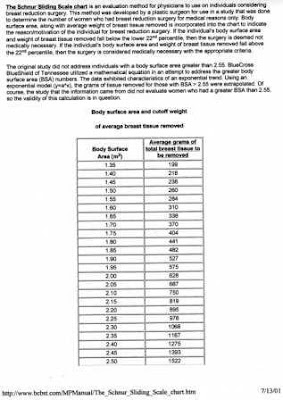
Recently I was trying to get a patient pre-approved for a bilateral reduction mammoplasty. I sent the usual letter which included her history, her complaints, my physical findings, and my estimate of the amount of breast tissue to be removed. A Polaroid of the the patient's breasts was sent, as required, with the letter. I referenced the Schnur sliding scale (a scale that uses the patient's height and weight to determine the minimum tissue needed for removal to give relief of their physical complaints). I was certain she would be approved as I felt she met all the requirements, but I like to be certain.
About six weeks after the letter was sent and several phone calls, I received (and the patient got the same copy) a letter denying the surgery as she failed to meet the minimal tissue removal guidelines. I need to remove how much tissue?!
I re-read the letter. They too referenced the Schnur sliding scale (SSS). I called the physician reviewer, feeling like they had just misunderstood. Their letter stated "tissue removed per breast". I understood the SSS to be "total tissue removed".
I actually had a very pleasant conversation / exchange with Dr Insurance. He listened and let my fax him my copy of the original article. He then called me back and informed me that I had misread the article. I was confused (granted it had been years since I had re-read it, but I "knew" what it said) but looked again as we talked. Damn, he was right. As he pointed out, the original article measured the amount of tissue removed from the RIGHT breast only and not both added together. So the scale is per breast not total tissue removed.
Well, I have been looking back over all the information I have and have finally figured out part of the source of my confusion (other than simply wanting it to be so, as it makes it easier to accommodate these women). I scanned in a copy of the BCBS Manuel page I printed out back in July 2001. Note the heading says "Total Breast Tissue to Be Removed". Today when I type in the web address at the bottom of the same page, this is what you will see "Tissue per Breast". Same web address, but they corrected it some time between 2001 and now.
Why does it matter? Well for a patient who weights 225 lb and is 5'8" tall (BSA 2.21), approximately 750 gms of tissue have to be removed from each breast, not 300 gm from one and 45o gm from the other for a total of 750 gm. That's approximately 1.5 lb of breast tissue per side, and for most women that size 3 bra cup sizes.
Another example, 5'1" tall and weights 155 lb. This woman would have a BSA of 1.74 and would have to have 400 gms of breast tissue per side removed. That's at least 2 cup bra sizes for her.
That seems fair. It's hard to promise them (the patients) that you can remove that amount sometimes. It can also be difficult to estimate the amount to be removed just by exam. There was a recent article (see reference #2) that has a formula for the estimation. I may try it and see if it is any better than my "eye". The formula is 35 X sternal notch to nipple distance in cm + 60 X nipple to inframammary crease distance in cm - 1240.
The woman that prompted all this, I estimated about 200-300 gm less per side than required. I'm not willing to make her a "B" cup just to meet the requirements (see my reasons here). And over-estimating the amount and then not meeting it can get a "not covered" and no payment after the fact. Thankfully, Dr Insurance approved her for me. He felt that I was doing her for the "correct" reasons. I appreciate the discussion we had.
REFERENCES
Reduction Mammaplasty: Cosmetic or reconstructive Procedure?; Annals of Plastic Surgery, Vol 27, No 3, Sept 1991, pp232-237
A Formula Determining Resection Weights for Reduction Mammaplasty; Plastic & Reconstructive Surgery. 121(2):397-400, February 2008; Descamps, Marjanne J. L. M.R.C.S.; Landau, Alex G. M.B.; Lazarus, Dirk F.C.S.; Hudson, Don A. F.R.C.S., F.C.S., M.Med.
Subscribe to:
Posts (Atom)