
Tuesday, June 14, 2011

Let’s Paint the World Red

Kudos to all blood donors.  Today is World Blood Donors Day!

Around 92 million blood donations are collected annually from
all types of blood donors (voluntary unpaid, family/replacement and paid). Approximately half of these blood donations are collected in high-income countries, home to 15% of the world’s population.
There are three types of blood donors: voluntary unpaid; family/replacement and paid. Voluntary unpaid blood donors are vital for ensuring a sufficient, stable blood supply.  Kudos to you all!
World wide, the greatest number of donors are younger than 25 year of age  (45% of all donors).  This isn’t the case in the United States.   Here those younger than 25 make up only 22% of all donors.  The age group with the greatest percentage of donors in the U. S. is  the group of  45 to 65 year olds (40%).
World wide, women make up only 40% of all donors.  In the U.S., the division is almost equal:  49.9% men/ 50.1% women.
……
The American Red Cross states every two seconds, someone in the United States needs blood.  More than 38,000 blood donations are needed every day.  Because blood can not be manufactured, it take blood donors.
All blood types are needed, but types O-negative, A-negative and B-negative are needed most.
So “let’s paint the world red.”  The world needs new and repeat blood donors to give blood.  Blood is the “gift of life.”

General Guidelines About Blood Donation

You must be healthy and be at least 17 years old. You must weigh at least 110 pounds. "Healthy" means that you feel well and can perform normal activities. Just because you have a chronic condition such as diabetes or high blood pressure does not mean you are un-eligible to donate. "Healthy" in light of a chronic condition means that you are being treated and the condition is under control.
Other aspects of each potential donor's health history are discussed as part of the donation process before any blood is collected. Each donor receives a brief examination during which temperature, pulse, blood pressure and blood count (hemoglobin or hematocrit) are measured.
To learn more blood donation opportunities, visit www.givelife.org or call 1-800-GIVE-LIFE (1-800-448-3543).

Related posts:
The Gift of Life (November 18, 2007)
Give Blood -- It's the Gift of Life  (August 1, 2009)

Shout Outs

Updated 3/2017:  all links removed as many no longer active and it was easier than checking each one.

David, Health Business Blog, is the host for this week’s Grand Rounds.  You can read this week’s edition here.
When I first hosted Grand Rounds six years ago, the iPhone, iPad and Twitter didn’t exist, and Facebook was not yet available to the general public. Barack Obama had not appeared on the scene and there was no discussion of the Affordable Care Act. Yet a lot of the topics in that edition would be familiar to today’s reader including firearms, RomneyCare, patient safety and Google. Two blogs (InsureBlog and Clinical Cases) that were featured in that early edition are featured here, too.. ……..
……………………………
Yesterday,  NPR ran this  article by Carrie Feibel:  Heart With No Beat Offers Hope Of New Lease On Life  (photo credit)
The search for the perfect artificial heart seems never-ending. After decades of trial and error, surgeons remain stymied in their quest for a machine that does not wear out, break down or cause clots and infections.
But Dr. Billy Cohn and Dr. Bud Frazier at the Texas Heart Institute say they have developed a machine that could avoid all that with simple whirling rotors — which means people may soon get a heart that has no beat.   ……….
………………………….
Clink Shrink, Shrink Rap, offers a thoughtful post on involuntary treatment:  Are We Not Thugs?  (read the discussion in the comments)
The voice at the other end of the line was angry and accusatory: "You didn't even talk to me! You never knew my son! You didn't talk to any of us!"
I explained to her that since she had never even met the defendant, there was no way she could have any information that would be relevant to the accused's state of mind at the time of the crime. The victim and the defendant were total strangers and there was no apparent reason for the killing, which made the crime even more tragic. Her son was dead in a random incident, in a crime that was unquestionably motivated only by the defendant's untreated psychiatric symptoms.    …….
………………………………..
Dr Val, Better Health, is now hosting a radio show called, "Healthy Vision with Dr. Val Jones."  It is currently available here on iTunes.  The show has three segments (one about the importance of regular eye exams, one about contact lens care, and one about UV protection for eyes). It's available as a full show (20 minutes) and as individual segments.
……………………………….
This essay (or article) from Stefany Anne Goldberg, The Smart Set, was in my local paper this past Sunday.  As that source is subscription only, I found it elsewhere to share with you.  The essay is Can You See Me Now? Welcome to Deaf-World
The 19th-century poet Laura Redden Searing, who happened to be Deaf, wrote a story about a lonely bird with crippled wings who comes upon the Realm of the Singing.    …..
What Deaf people have realized about themselves in the last century is that being Deaf opens up a new mode of experience. And ASL is the language of that experience. Deaf people were creating their own world. But it was a world they would have to defend.

The newly published The People of the Eye sets out to define the Deaf-World and to fight for it. Where Deaf activists have spent decades arguing that deafness is not a defect but a character trait — a benefit even — The People of the Eye goes a step further. It asserts that Deaf is an ethnicity.  …….
…………………………………….
A few responses to the NY Times article by Karen S. Sibert:  Don’t Quit This Day Job
@medrants:  Medrants: Women in medicine - different strokes for different folks
@palmd: From the Underground NYT: Women are ruining medicine
I've written before about many of the challenges faced by women in medicine.  As more and more women enter medicine, there is a cultural shift struggling to be born.  ……….
As a society and a profession, we have to decide to take the role of women seriously. If we demean women's role in our profession, we may be more likely to demean our female patients and family members.
Richard L. Reece, MD (Medinnovation):  Health Reform, Women Physicians, and the Doctor Shortage
@scutmonkey:  Psychology Today:  The Mommy Wars, Medical Edition
……………………………………………..
Leah, Free Motion Quilting, is one of the quilting blogs I follow.  She was recently listed as one of Quilter's Home Top 55!
Whoo Hoo! I was listed in the top 55 blogs by Quilter's Home Magazine!
Click here to read the magazine article and check out all the different blogs listed
This is crazy cool because one of the sort of kick butt moments of my life was when my Dad picked up a Quilter's Home magazine 2 years ago that had a similar blog and website list.
So is Barbara Brackman’s Material Culture blog.

Monday, June 13, 2011

Museum Exhibit: Violence, Women, and Art

 Updated 3/2017-- all links (except to my own posts) removed as many no longer active.

I stumbled upon the news of this exhibit when I visited the CDC’s website and clicked on the button  “CDC Museum.”    Did you know the CDC had a museum?  Well, I don’t think I was aware of it.
This exhibit opened June 6th and will run through September 9, 2011 at the CDC’s Global Health Odyssey Museum.  The exhibit, Off the Beaten Path: Violence, Women and Art, focuses on the prevention of violence against women. 

The work of 28 contemporary artists from 24 countries is presented.  The art works address the issues of violence against women and girls around the world and their basic human rights to a safe and secure life.
Among the artists featured in Off the Beaten Path are: Yoko Ono (Japan), Louise Bourgeois (France), Wangechi Mutu (Kenya), Mona Hatoum (Palestine), and Hank Willis Thomas (USA).
The project which I was able to view online is powerful, emotional.  The exhibit can be viewed online:  Off the Beaten Path virtual exhibition (link no longer active, 3/2017)
or you can attend in person at the Global Health Odyssey Museum.  Their hours are Monday through Friday, 9 AM – 5 PM with hours extended on Thursday to 7 pm. The museum is closed on all federal holidays.

Some of the CDC’s quick facts on violence against women:
About one in 11 teens reports being a victim of physical dating violence each year.1
About one in four teens reports verbal, physical, emotional, or sexual violence each year.2
About one in five high school girls has been physically or sexually abused by a dating partner.3
Each year, women experience about 4.8 million intimate partner related physical assaults and rapes. Men are the victims of about 2.9 million intimate partner related physical assaults.4
Intimate partner violence (IPV) resulted in 2,340 deaths in 2007. Of these deaths, 70% were females and 30% were males.5
The medical care, mental health services, and lost productivity (e.g., time away from work) cost of IPV was an estimated $5.8 billion in 1995. Updated to 2003 dollars, that's more than $8.3 billion.6, 7

Related post:
Domestic Violence  (May 11, 2010)

Friday, June 10, 2011

Under the Tree

The batik used in the center of this quilt was a lone square of fabric which I didn’t want to cut up.  I felt lucky that it had the nice scene featured.  I noticed I had just enough of the border print I used for the inner frame.
The quilt is machine pieced and quilted.  It measures  9 7/8 in X 9 5/8 in. 
Here you can see how I used dark green thread to make the metallic tree and figures stand out even more.
The outer border fabric is a black print which looks gray/black but photographs blue/black.
The back has a sleeve for hanging.

Thursday, June 9, 2011

Advances in Surgical Treatment of Facial Nerve Paralysis in Children – an article review

 Updated 3/2017-- photos and all links (except to my own posts) removed as many no longer active.

I read the second article below first.  I was struck by the opening paragraphs of Daniel Alam, MD’s commentary which note the importance of smiling in human communication and how it is often taken for granted EXCEPT by those who have lost the ability to smile.
This is far from the case for patients who have lost the ability to smile. Patients who have endured facial paralyses (even in the transient cases that occur in certain idiopathic facial nerve palsies, ie, Bell palsy) understand the true psychological effects of this disability. …...
I can attest to this on a personal level having had Bell’s palsy in 2002.  I have a quilt I’d like to make, a personal portrait ala Picasso, that would reflect the way it affected me.  I can’t seem to get it worked out yet, but will.
Back to these articles.  Alam commends Hadlock and colleagues (the first article below) for not just relying on emotional checks from the patients who often feel any improvement is a great result (bold emphasis is mine):
… Although this report is another well-designed clinical series of a well-established surgical technique, the true significance of this work extends far beyond the patients presented. ….This group, more than any other in facial plastic surgery, has made a concerted effort to quantify (to measure and validate) the outcomes they report. …
With that recommendation went looking for the Hadlock’s article.  
Hadlock and colleagues begin with background information which notes “free muscle transfer for facial reanimation has become the standard of care in recent decades and is now the cornerstone intervention for dynamic smile reanimation.”
While myriad muscles have been transferred into the face to restore the smile, most large series describe the use of the gracilis muscle, the latissimus dorsi muscle, or the pectorals minor.  Of these, the gracilis muscle is the most widely used, based on predictable pedicle anatomy, an acceptable donor deficit and scar, and favorable muscle microarchitectural features resulting in fast and robust excursion when activated.
Hadlock and colleagues used their SMILE program to objectively measure the functional outcome of 17 pediatric patients who had undergone 19 consecutive pediatric free gracilis transplantation operations.  The procedures were done over a 5-year period from October 2004 through September 2009.  The mean age of the patients was 11.5 years (range, 4-18 years).
All patients were prospectively administered the Facial Clinimetric Evaluation (FaCE) instrument which is a validated, standardized QOL instrument for patients with facial movement disorders.   Hadlock’s article referenced the Laryngoscope (3rd reference below) article for FaCE.
Hadlock and colleagues results
The mean commissure excursion improvement was 8.8 mm ± 5 mm (Figure 4), commensurate with the findings in other facial reanimation series.   When subdivided into those driven by a cross-face nerve graft vs those driven by the masseteric branch of the trigeminal nerve, the latter provided more excursion on average, as expected.
There was only one muscle failure in the series.  It resulted from an arterial thrombosis.
In conclusion:
In conclusion, free gracilis transfer for smile reanimation in children carries an acceptable failure rate, significantly improves smiling, and seems to improve QOL with respect to facial function. It should be a cornerstone intervention in the appropriately counseled patient and family. Because it carries a lower failure rate than a similar cohort of adult patients, there is no need to wait until patients reach adulthood to offer dynamic reanimation. Early facial reanimation provides the advantage of permitting children to express themselves nonverbally through smiling and may in fact lead to fewer negative social consequences as they interact with peers.


REFERENCES
1.  Free Gracilis Transfer for Smile in Children:  The Massachusetts Eye and Ear Infirmary Experience in Excursion and Quality-of-Life Changes; Hadlock TA, Malo JS, Cheney ML, Henstrom DK; Arch Facial Plast Surg. 2011;13(3):190–194; doi: 10.1001/archfacial.2011.29
2.  Advances in Surgical Treatment in Facial Nerve Paralysis in Children (commentary); Daniel Alam, MD; AMA. 2011;305(20):2106-2107;  doi: 10.1001/jama.2011.689
3.  Validation of a patient-graded instrument for facial nerve paralysis: the FaCE scale; Kahn JB, Gliklich RE, Boyev KP, Stewart MG, Metson RB, McKenna MJ; Laryngoscope. 2001;111(3):387–398.

Wednesday, June 8, 2011

Imagine

Updated 3/2017-- photos and all links (except to my own posts) removed as many no longer active. 

As you may know, I sew.   I grew up sewing many of my own clothes.  Now it’s mostly quilts, but I still occasional make an item of clothing.
It’s always fun to imagine how a certain pattern would work on the intended person (me, a friend, a niece, etc), how it would look in this fabric, this color, this print.
Always fun to imagine where you might wear the new dress, the new shirt, the new skirt.  Always fun to imagine how you might accessorize it.  Imagine the new shoes you might need.
Burda has a sewing blog I follow.  Yesterday one of their posts was title:  6 New Patterns in Sizes 44-52.  I was hopeful the featured models would be the same sizes.  They didn’t.  (photo credit)
Even worse, the models aren’t even shown wearing the pattern (inset) featured. 
Now, while I can look at the inset and imagine how it might look on me, in this fabric or that, in this color or that, what I really want to imagine is wearing the lovely dress on the right.
Wouldn’t it have been much more fair to a size 44-52 women who wants to look her best to feature the pattern made in the appropriate fabric on a woman her size?
I’m not the only one who feels this way.  Here’s a sampling of the comments:
by lila-1:  Aside from the fact that you have modeled the ‘plus size’ designs on skinny girls (wth??), the majority of these patterns are bordering on muumuus
……
by Julianne Dodds:  I can’t really weigh in (ha!) on if these are good styles for plus-sized gals cause I don’t see any examples :P
I wish all women were a healthy size, athletic and active,  but we aren’t.  Pattern companies, as well as clothing manufactures, should provide appropriate models.  Size 2 – 6 models when selling to size 44 is NOT appropriate.

Check out Dr. Val’s recent post on Accepting Different Body Types, But Not Embracing Obesity

Tuesday, June 7, 2011

Shout Outs

 Updated 3/2017:  all links removed as many no longer active and it was easier than going through each one.

Grand Rounds continues to be on hiatus.  If you would like to host a future edition of Grand Rounds send an email to Nick Genes (you can find his contact info at here).   The most recent edition can be found here at Medgadget.  Other editions can be found here on the Grand Rounds Facebook page.
……………………………
Kim, Emergiblog, is the host of the latest edition of Change of Shift (May 2011)! You can find the schedule and the COS archives at Emergiblog.
Welcome to the latest edition of Change of Shift, the nursing blog carnival!
…..Let’s get started!
**********
Sue Hassmiller is the Robert Wood Johnson Foundation Senior Advisor for Nursing. She is also a volunteer with the Red Cross. Abandonment Guilt, her final blog post from tornado-ravaged Alabama, can be found at AJN’s Off the Charts.
Best. Post. EVER! From BabyRNDeb at Life and Times of an L&D Nurse. What a difference One Year can make!
Over at oncRN, “the silence needs to be listened to and honored.”   …….
………………………………..
H/T to @palmd  for the link to this article by  @stevesilberman:  23 amazing writers offer me tips on writing a book.  Here are just a few:
Bill Wasik (Author of And Then There’s This: How Stories Live and Die in Viral Culture) --
The first tip is that readers expect books to be exhaustive on their subjects. That doesn’t mean they want the books to be long ….
Deborah Blum (Author of The Poisoner’s Handbook and Ghost Hunters)  -- …..the best advice i got in writing narrative non-fiction was to get my hero in trouble and keep him there. …..
Sylvia Boorstein (Author of Happiness is An Inside Job and It’s Easier Than You Think)  -- …..Do not read other people’s work on the same subject. That might be hard for you, since you are collecting research data, but I say very little about what other people have said or thought. They’ve already said or thought it. ….
……………………………….
Kerri (@sixuntilme)  who will soon be a 25 year Medalist shares a Video from the Joslin 50 Yr Medalists.   Amazing and inspiring.  Go check it out.
To be a Joslin Medalist, you need to mark 25, 50, or 75 years with diabetes.  (Well, technically, you get a certificate at the 25 year mark, but it's definitely a milestone to celebrate.)  And over the weekend, I had the opportunity to spend the day with Joslin's medalists who have spent over 50 years with type 1 diabetes. 
……  These generous medalists allowed me to listen to their stories, and offered a few sage words of advice into my video camera. …..
…………………………………….
Not only is this year the 30th Anniversary of HIV/AIDS, but Margaret Polaneczky, MD (TBTAM) reminds us it’s also the 40th anniversary of the seminal journal article on DES – An Endocrine Disruptor
An interesting NEJM article on the 40th anniversary of the seminal journal article on The DES Story serves as a potent reminder of the potential effects of exposure to endocrine disruptors during critical times in development.
Beginning in the early 1960′s DES, a synthetic estrogen compound, was given to women in early pregnancy to prevent miscarriages. Females born from these pregnancies had an increased risk of a rare vaginal cancer during childhood, increased rates of uterine malformations that can cause infertility and premature birth, and are at a moderately higher risk for breast cancer. Use of DES in pregnant women stopped in the early 1970′s.  . ……….
…………………………….
What great news this week regarding the treatment of melanoma.  Check out this NY Times article by Andrew Pollack:  Drugs Show Promise Slowing Advanced Melanoma
Two new drugs have been found to prolong the lives of people with advanced melanoma, representing what researchers say is notable progress against the deadly skin cancer after decades of futility.
The drugs represent success in two new approaches to combating cancer: one by attacking a specific genetic mutation that accelerates tumor growth; the other by unleashing the body’s immune system to fight the disease  ……….
The drugs do not cure melanoma, except perhaps in rare cases.   …………
…………………….
Shared by @DrVes on twitter:  The days of his life: NY photographer takes Polaroid picture every day for 18 yrs until his death from cancer at 41 (photo credit)
What started as a project, quickly became an obsession for one New York photographer, who managed to take a Polaroid picture every day for 18 years.
Jamie Livingston took his first snap of then girlfriend Mindy Goldstein and a friend on March 31 1979.
Six thousand shots later the series ends tragically on 25 October 1997 with Mr Livingston on his deathbed from cancer on his 41st birthday.  ……….
To see the whole collection go to www.photooftheday.hughcrawford.com
……………………………………………..
I read about this quilt by Cathy Ott in my local Sunday paper but it’s subscription only online and there was no photo with the article.  So I googled it and found this Journal Sentinel article which had a photo (the one below):   Military uniforms across decades go into gift of quilt
Zach Radtke didn't notice right away when a few of his Army uniform patches went missing.
The next time the Army Reservist saw them, they were on a beautiful quilt made by his girlfriend's mother. Five different Army uniforms spanning several decades make up the quilt.
When Cathy Ott came up with the idea for her military camouflage quilt she calls "The Boot," she didn't need to do much shopping for old military uniforms. She just opened her closet. ……

Monday, June 6, 2011

Thoughts on the AIDS/HIV 30th

Updated 3/2017-- photos and all links (except to my own posts) removed as many no longer active. 

The first reports of the infection which would come to be known as AIDS appeared in the June 5, 1981 issue of CDC’s MMWR.  The 5 cases reported in the MMWR involved young homosexual men being treated for Pneumocystic carinii pneumonia.  All were in Los Angeles, California during the period October 1980-May 1981.
I did not become aware of this disease until the fall of 1982 as an intern in Baton Rouge, LA.  Our patient presented with Kaposi sarcoma.
Last week I had a short discussion with a friend who is an HIV expert here in Little Rock, AR.  He graduated from medical school a year ahead of me.  He first recalls hearing of HIV when the NEJM article appeared in December 1981.  He mentioned taking note of the article and thinking he would never see any of those cases.
We both marveled over how the diagnosis of HIV has gone from an automatic death sentence to a chronic disease the person can live with.  LIVE with HIV.
He noted the change came in the 1995 with the introduction of highly active antiretroviral therapy (HAART).  My friend went from feeling like he might need to give up treating AIDS/HIV patients (too many deaths were taking it’s toil on him) to feeling hopeful for his patients.
We both noted that prevention continues to fail.  He mentioned he often will have a patient with a birth date of 1987 or so who will present to his office.  Not good as this age group has always had HIV prevention discussed in the media, etc during their lifetime.
Even though HIV is not the death sentence it once was, prevention needs to remain a major focus.
It is important to know your HIV status so that treatment can begin early. It is especially important to be tested yearly if you participate in any of these behaviors:
  • Have injected drugs or steroids or shared equipment (such as needles, syringes, works) with others
  • Have had unprotected vaginal, anal, or oral sex with men who have sex with men, multiple partners, or anonymous partners
  • Have exchanged sex for drugs or money
  • Have been diagnosed with or treated for hepatitis, tuberculosis (TB), or a sexually transmitted disease (STD), like syphilis
  • Have had unprotected sex with someone who could answer yes to any of the above questions
If you test positive for HIV, then it is important to see a doctor, preferably one with experience treating people living with HIV.


REFERENCES
Pneumocystis Pneumonia --- Los Angeles: CDC MMWR, June 5, 1981 / 30(21);1-3
Gottlieb et al. Pneumocystis carinii pneumonia and mucosal candidiasis in previously healthy homosexual men. NEJM (1981) 305:1425-1430
Kent A. Sepkowitz, M.D.; AIDS — The First 20 Years; N Engl J Med 2001; 344:1764-1772
CDC:  HIV
Aging with AIDS: Living longer, living with loss; Linda Dahlstrom; MSMBC News, June 2, 2011

Sunday, June 5, 2011

MyPlate – Size Matters

Updated 3/2017-- photos and all links (except to my own posts) removed as many no longer active. 

The new food “pyramid” was unveiled this past Thursday.  It is now in a much simpler form – a plate.  What I didn’t find defined at the ChooseMyPlate website is the plate size. 
So I googled “standard dinner plate size.”  Here is the answer:
It can be helpful to know the manufacturers intended use for an item, but it is important to remember that you can use the item in whatever way that works for you!
Dinner plate 10 to 10 3/4"
Luncheon plate 9 to 9 1/2"
Salad plate 8 to 8 3/4"
Bread and butter plate 5 to 7 3/4" (usually about 6")
When found, dessert plates are generally somewhere between salad plates and bread and butter plates in size. Dessert plates are not common, so the salad plate doubles as a dessert plate in most patterns.
Another size that you might see in a pattern is one that is larger than a dinner plate. These are frequently call buffet plates, service plates or chargers and are usually 11" to 12" in diameter.

Chris Maddera makes this point in his essay:  The Psychology of Dinner Plates  (bold emphasis is mine)
….the size of our dinner plates was a major contributing factor of Americans becoming overweight.
Here’s the way it works: the diameter of a typical American dinner plate is 11 inches; the diameter of a typical European dinner plate is 9 inches. πr2 shows that the 2-inch difference amounts to the 11-inch plate having 50% more surface area than the 9-inch plate. If, like most people, you fill your plate, you’re putting 50% more food on it than a person with the 9-inch plate.
This means we’re eating 50% more food, since we usually eat whatever is on our plates. Or, to look at it differently, we feel full when our plate is empty.
By the way, some restaurants use 13-inch plates, which means it’s twice as big as the 9-inch plate.

Size of the plate matters as does the choice of food we put on it.  Don’t use the larger plates for your children or if you are a petite female.  Consider not covering up the entire surface area.
And don’t forget to get up and move – walk, swim, dance, bowl, etc. 

Friday, June 3, 2011

Miniature American Flag Quilt

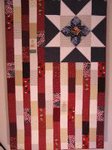
This miniature American Flag quilt is similar to this one and this one, only much smaller.  It is a basic brick pattern for the strips. Each brick measure 0.5 in X 1 in.  I placed a purple heart in the star field.
The quilt is machine pieced and quilted.  It measures 7.25 in X 11.5 in.
The purple heart is machine appliqued.
The back features “fast triangles” for hanging ease.

Thursday, June 2, 2011

Caring for Horse and Donkey Bite Wounds

 Updated 3/2017--  all links (except to my own posts) removed as many no longer active.

Earlier this week this tweet from @prsjournal caught my eye
Most Popular: Management of Horse and Donkey Bite Wounds: A Series of 24 Cases: No abstract available http://bit.ly/lgNkCS
I missed this article when it came out in the June 2010 issue of the Plastic and Reconstructive Surgery Journal.  As I have covered fire ant bites, cat bites, and snake bites.  Fellow blogger Bongi has written about hippo bites.  It’s time to cover horse and donkey bites. 
Dr. Köse, Department of Plastic and Reconstructive Surgery, Harran University Hospital, Turkey and colleagues presented a retrospective evaluation of 24 patients treated for animal bites (19 horse and five donkey bites) from 2003 to 2009.  The head and neck were the most frequent bite sites (14 cases), followed by the extremities (8 cases) and the trunk (2 cases).
The article is very short, representing their personal viewpoint and experience. 
Our experience shows the safety of primary closure for horse and donkey bite wounds, provided that careful debridement and good cleansing with antibiotic prophylaxis are also performed. An acceptable aesthetic outcome can be achieved only with early primary repair and reconstructive procedures.
Dr. Köse note that horse and donkey bites often result in tissue loss wounds.  Their review of the literature (not sure how extensive) found one reported case of anaphylaxis after a horse bite and one case of a deep crush injury with hematoma, fat necrosis, and muscle rupture without an external wound in a woman bitten on her thigh by a horse.
As I shared in my post Assessing and Managing Mammal Bites – an Article Review
  • Thoroughly examine patients with bites.  Especially with children, check the entire body to identify additional injuries.
  • Examine the wound itself meticulously. It’s easy to miss things.
  • Be alert for injuries to the vasculature, nerves, tendons, bones, and joints.
  • Bites from large mammals can damage and even fracture bone.  Plain radiographs should be viewed after the exam.
  • Large mammals who bite and shake can dislocate joints. Have patients perform active range-of-motion with joints that are near bite wounds.
  • Use plain radiography to assess for retained foreign bodies and skeletal injuries. Computed tomography and magnetic resonance imaging have increased sensitivity for foreign bodies and subtle fractures.
As with all wounds, standard wound care applies.  This means copiously irrigate and debride as needed.  Bites are tetanus-prone wounds. Review the patient’s immunization records.  Give updates, etc as needed.


REFERENCE
Management of Horse and Donkey Bite Wounds: A Series of 24 Cases; Köse, Rüstü; Sögüt, Özgür; Mordeniz, Cengiz; Plastic & Reconstructive Surgery. 125(6):251e-252e, June 2010; doi: 10.1097/PRS.0b013e3181d515dd

Wednesday, June 1, 2011

Recovery of Sensation Post-Facial Transplantation

 Updated 3/2017-- photos and all links (except to my own posts) removed as many no longer active.

Have you ever lost your sense of smell or taste?  Recall how it feels when your face/mouth don’t work properly until the nerve blocks wear off after a dental procedure.
Those are all things (and more) a facial transplant patient has to deal with.  The article discussing recovery of sensation after facial transplantation in the May issue of Plastic and Reconstructive Surgery discusses this topic (first reference below).
In addition to reviewing their own face transplant patients (n=4), Dr. Maria Siemionow and colleagues did a literature review (English literature for peer-reviewed articles published between 1940 and 2010) of sensory recovery after various standard nerve repair techniques. 
These other nerve repair techniques included repair of the peripheral branches of the trigeminal nerve; sensory return after free tissue transfer (ie noninnervated flaps, including radial forearm, lateral thigh, anterolateral thigh, latissimus dorsi, trapezius, et al and innervated free flaps, including radial forearm, anterolateral thigh, and rectus abdominis musculocutaneous flaps); and sensory recovery following replantation of scalp and forehead.

Image: Pathways of sensory recovery in face transplantation are summarized.
(1) Direct sensory nerve growth through microsurgical nerve repair.
(2) Trigeminofacial communications.
(3) Nervi nervorum of the facial nerve.
(4) Somatic afferents of the facial nerve.
(5) Adrenergic plexus of the vascular pedicle.


Siemionow and colleagues report that only one of the four face transplant recipients underwent direct repair of the sensory nerves.  In the other three cases, it was impossible to reconnect the nerves because of technical difficulties or the severity of the patient's injuries.
Even so, all four patients began regaining sensation in the transplanted face as early as two weeks after surgery and had normal or near-normal sensory function by the end of the first year.
The extent of recovery was similar to that achieved with simple repair of injured sensory nerves in the face-and even better than that of grafting procedures where tissues are transferred to the face from different areas of the body without reconnecting the nerves.
Siemionow and colleagues note in their discussion:
Based on the results of our comparative analysis, we can conclude that, in the absence of extensive soft-tissue injury, simple repair of facial sensory nerves leads to restoration of nearly normal sensation. ….. Interestingly, face transplantation is the only clinical condition where, in the absence of sensory nerve repair, good functional outcome is achieved despite severe trauma causing soft-tissue and sensory nerve damage.
As they also note (bold emphasis is mine)
An important issue that emerged from the comprehensive review of the literature is an evident lack of universal methods of neurosensory assessment and an urgent need for establishment of guidelines that will help with comparative analysis of the sensory recovery data. This applies to the reported cases of face transplantation, where documentation of sensory recovery is either marginal or overlooked.

For the face transplants, as with head injury patients, the olfactory nerve function needs to be assessed as well and it wasn’t in this study.   If the person can’t smell smoke or gas leaks, then extra care or caution has to be taken at home.

REFERENCE
Pathways of Sensory Recovery after Face Transplantation; Siemionow, Maria; Gharb, Bahar Bassiri; Rampazzo, Antonio; Plastic & Reconstructive Surgery. 127(5):1875-1889, May 2011; doi: 10.1097/PRS.0b013e31820e90c3
Discussion: Pathways of Sensory Recovery after Face Transplantation; Chong, Tae; Plastic & Reconstr Surgery 127(5):1890-1891, May 2011; doi: 10.1097/PRS.0b013e31820e88c9
ASPR Press Release, May 9, 2011:  Sensation Recovers to 'Near-Normal' After Face Transplant, Study Finds
Setting Goals, Rehabilitating After Brain Injury; NPR, May 16, 2011