Wednesday, November 21, 2007

Another Tactile QOV Quilt

Updated 3/2017-- all links (except to my own posts) removed as many no longer active.

Back in June I wrote about the need for tactile quilts for blind or sight-impaired soldiers. The tactile sense training seems to help them train the brain to "see" in other ways. The reason is not fully understood, but is known as sensory substitution. This refers to the capacity of the brain to replace the functions of a lost sense by another sensory modality. The most commonly used form of sensory substitution is Braille reading which allows the blind to read by touch (somatosensory system).

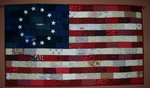
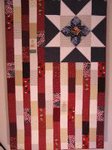
For the one I am working on now, I used cottons, washable fake fur (polyester zebra print), and old denim. There are four working pockets from the black denim jeans (trouser style). One pocket even has the button-flap. I hadn't intended for it to look "Christmasy" but it does. It is black and white, red, and green in color. The backing fabric is a flannel of the same colors. I am doing a simple "out-line" quilting stitch on my sewing machine. No hand quilting for these thick fabrics (the denim and fake fur). It does have a "nice touch". I hope to finish it over this weekend between family events.
I don't have a name for this pattern. I found this "picture puzzle" in the paper and adapted it.

Here is the flap pocket.
The finished quilt size is 52" X 62".

Tuesday, November 20, 2007

Grand Rounds 4:09

Updated 3/2017-- video and all links (except to my own posts) removed as many no longer active.

I don't have any posts highlighted in Grand Rounds, but I would like to send you over there. Enrico (Mexico Medical Student) has done a wonderful job. The music he highlights is enough to send you there. The posts he links are just extra.
"In the Thanksgiving spirit, all of today’s selections will highlight American composers. Since all links here are set to open in new windows (or tabs), you can read articles while leaving this window playing in the background. In all but one shorter case, the selections are about 8 minutes each; I hope you indulge my desire to share. Enjoy!"
YouTube - Andra Voldins and Mark O'Connor Appalachia Waltz

Monday, November 19, 2007

NanoScience and Medicine

Updated 3/2017-- photos and all links (except to my own posts) removed as many no longer active.

I am on the Industrial Advisory Committee of the University of Arkansas' microEP Graduate Program. At my first meeting this past spring, I found myself feeling out of place as each person introduced themselves and their credentials. The other members come from companies such as Power Technology Inc, Air Force Research Lab, ITT Industries Space Systems Division, Texas A&M, Genesis Technology, Space Photonics, Lockheed Martin Coherent Technologies, Texas Instruments, and Bell Labs. I truly felt as if I might not have anything to contribute. I had been asked to serve on the committee because I was a graduate of the Physics Department (1978), was in health care, and was willing.
The program is an "interdisciplinary graduate program designed to expand a student's knowledge beyond the boundaries of traditional departmental based graduate programs. Students in the Microelectronics-Photonics program will participate in cross-departmental research, will take applications-intensive classes from multiple engineering and science departments, and will develop workplace productivity skills in a simulated industrial environment.
The outcome of their graduate education in this interdisciplinary environment will be a better understanding of microelectronic-photonic materials; the creation of high-performance, miniaturized devices and systems made from these materials; and an understanding of the economics that affect successful introduction of these devices and systems into industry and the community."
I feel as if I may get more out of this association than they do. I will get to learn more about these nano-particles which are amazing. I recently meet a science writer, Lakshmi Gopal, through on-line friends. She sent me this article on Nanotubes in Biomed Applications. It highlights the wonderful possibilities of this technology in medicine. Check out the article, it is a very good read. (photo credit)

Sunday, November 18, 2007

SurgeXperiences 109--Call for submissions

Updated 3/2017-- photos and all links (except to my own posts) removed as many no longer active.

Haree Haree!

SurgeXperiences 109 (the only surgery blog carnival) is coming to Monash Medical Student next Sunday, November 25. He is accepting all posts related to surgery and your experiences from surgeons, attendings, residents, anesthesiologists, nurses, students, patients, etc.
You can submit your articles to Jeffery via this form. If that fails for some reason or another, there is always his e-mail.
photo credit

The Gift of Life

I try to give blood a few times a year. I have no luck getting my husband to give. I hope I can convince a few of you to give. As we approach this Thanksgiving and Christmas season, there is a gift you can give that will not cost you any money--just a little time and yes a needle stick. But compared to the good it will do for someone like Dr. Smak's son Henry, what's a little needle stick.

And since most of us aren't close enough to Dr. Smak or her family to give then a physical hug or take them a casserole dish or do a load of laundry for them, this is a way that those of us who have befriended her in this cyber-world can do something for them (or another family like theirs). So please give blood this "giving season". As the t-shirt says, you'll be giving someone another birthday, another anniversary, another chance.

Saturday, November 17, 2007

Mastopexy

 Updated 3/2017-- photos and all links (except to my own posts) removed as many no longer active.

Mastopexy, or breast lift, is a procedure designed to improve the appearance of sagging or ptotic breasts (pick them back up). The goal of surgery is to improve the shape of the breast while minimizing visible scars. Many procedures and many modifications of the mastopexy have been suggested to try to achieve this end result.

The classification system (suggested by Regnault and modified by numerous authors) is as follows:
Grade 1: Mild ptosis -
  • Nipple just below inframammary fold but still above lower pole of breast
Grade 2: Moderate ptosis -
  • Nipple further below inframammary fold but still with some lower pole tissue below nipple
Grade 3: Severe ptosis -
  • Nipple well below inframammary fold and no lower pole tissue below nipple; "Snoopy nose" appearance
Pseudoptosis -
  • Inferior pole ptosis with nipple at or above inframammary fold; usually observed in postpartum breast atrophy

There are no medical treatments of breast ptosis. It takes surgical removal of skin and/or adding an implant to fill up the excess skin envelope. There are no absolute contraindications for breast lift surgery. However, if you plan future pregnancies, because lactation and subsequent involution will further change the shape of the breast, it is best to delay the mastopexy surgery until after those future pregnancies. In patients who are at high risk of primary or recurrent breast cancer, consideration of whether a mastopexy will alter the breast architecture and add scar tissue within the breast tissue needs to be considered, as this may make detection or treatment of cancer more difficult. It is best to be a non-smoker.

Some guidelines for surgical correction:
Minimal or minor breast ptosis
  • can be corrected with breast implant augmentation.
  • can be corrected with periareolar skin resection (around the nipple complexwith or without augmentation. (photo credit)
Grade 2 ptosis
  • Minor grade 2 can be corrected using a circumareolar donut mastopexy including the cerclage techniques as described by Benelli.
  • Moderate grade 2 ptosis can be addressed using the vertical scar mastopexy procedures, including the Regnault B technique and Lejour/Lassus techniques. (photo credit)

Severe grade 2 ptosis and grade 3 ptosis
  • This degree of ptosis usually requires inverted T incisions regardless of the pedicle used. (photo credit)

Pseudoptosis
  • can be addressed with augmentation and/or skin excision without nipple transposition (excision of lower pole skin) or with the circumareolar cerclage technique.

Complications:
General complications can include bleeding, infection, and problems secondary to anesthesia.
Specific complications include skin necrosis, sensation changes, and asymmetry. Seromas and hematomas, although relatively uncommon, can pose significant problems when they occur. Nipple necrosis can occur due to tension, torsion, or pedicle compression. Overaggressive undermining can lead to necrosis of the skin flaps or NAC. Neither necrosis of the nipple nor skin flap loss occurs frequently. The inverted T incision increases wound breakdown at the junction of the 3 limbs. Scars usually heal without hypertrophy problems.
Asymmetry is almost always present preoperatively, and it is unlikely to be eliminated completely regardless of the technique employed or the experience of the surgeon. Augmentation performed in conjunction with mastopexy can make correction of asymmetry even more difficult.
The periareolar approach can result in under projection of the central portion of the breast, in addition to stretching of the areola. When augmentation is performed with mastopexy, risk of postoperative asymmetry is increased. Augmentation brings its own complication/risk list (capsule formation, deflation, etc).

Something to think about:
The lift done alone does not tend to change your breast size (volume). An exception to this is extreme Grade 3 ptosis where the amount of skin removed may be large enough to make a perceptible change in volume.
So when thinking about having a breast lift with or without an augmentation, give some thought to whether you want breasts the same size or larger when healed. If you want to be the same size, only "picked up" then the scars needed will be worth it. If you want to be larger, then you will have to be willing to have breast implants added into the picture. Go into this informed and don't let your surgeon tell you that you need an implant if you don't want to be larger breasted. I say this because I have removed implants for a couple of women this year who only wanted to be lifted (and are okay with their scars) and did not want to be larger in the first place. Their first surgeon "talked" them into the implants (smaller scars) which they then had removed--both within less than two years after the first procedure (augmentation procedure).
References
Breast Mastopexy by Jorge I de la Torre, MD--eMedicine Article
Breast Lift Mastopexy Videos and Movies Before and After Surgery Gallery--Michael Bermant, MD
Breast Lift (Mastopexy)--American Society of Plastic Surgeons
Photo of Grade 3 Ptosis, before and after correction, no implant--Dr R. V. Dowden
Surgery of the Breast: Principles and Art By Scott L. Spear--Google eBook (or purchase through Amazon.com)






Friday, November 16, 2007

They didn't fall.

Updated 3/2017-- photos and all links (except to my own posts) removed as many no longer active.

She'd just had a mastopexy the week before and was in for her first postop visit. Before I had a chance to ask how she was, she said to me, "When I went in the bathroom to shower for the first time and took the bra off, you know what struck me?"
I said what I thought she would say because it's what most patients focus on early postop, "The incisions, the new cuts." I was ready to give her a pep talk.
Her reply, "No. They didn't fall. They stayed up! I love them."
She was truly thrilled. I was thrilled. She'd given me a new perspective to give to future patients. Instead of just telling them to remember that the fresh incisions will heal and the scars will fade, I can remind them to "notice that they didn't just fall when you took your bra off".
(photo credit)

Thursday, November 15, 2007

Emergiblog News


 Updated 3/2017-- photos and all links (except to my own posts) removed as many no longer active.

Change of Shift is up over at Emergiblog. Kim states that it is the best of the nursing blogosphere! And I, for one, listen to good nurses. So head over and check it out.
Then tonight Dr. Anonymous will be interviewing Kim on BlogTalkRadio so if you can tune in.

SurgeXperiences 108

Updated 3/2017-- photos and all links (except to my own posts) removed as many no longer active.

I am so happy to tell you that SurgeXperiences 108: Snow White and the Seven Surgeons is up over at Aggravated D0c Surg. He has done a wonderful job! Head on over for some good reads. Don't forget to "whistle while you work".
Next up for SurgeXperiences is the Monash Medical Student, who will host on November 25th. Get your posts lined up by the 23rd!

Wednesday, November 14, 2007

Things Happen

Updated 3/2017-- photos and all links (except to my own posts) removed as many no longer active.

I had a visit from an old high school teacher earlier this week. She (Mrs. R) just dropped by to say hello. She was in the building anyway. Luckily I wasn't busy at the time, so we sat and chatted. Mostly she chatted and I listened. Retirement has not turned out the way she had hoped it would. She is in good health, but her dear husband of 50 years is not. He has severe Parkinson's Disease. She is such a sweet woman, no bitterness to her at all, as she lovingly takes care of him.
She needed to tell me that she had almost lost him yesterday. He was sitting at the kitchen counter while she cleaned. It had been a frustrating morning, as she had not been able to get him to eat or drink much. So she had changed gears and was just talking and singing to him while she cleaned. Then she noticed that his mouth "looked funny". When she checked, he was missing his upper partial plate. The bottom one was still in place. He looked okay otherwise. She looked around and couldn't find it on the counter, in his lap, or on the floor. (photo credit)
Then he began to make a funny noise, so she checked his mouth again and saw it lodged at the back of his mouth in his throat. She had never thought about him swallowing it, "The denture it is so big". But there it was and she couldn't get him to cough it out. She couldn't get a good hold on it with her fingers. She took me through all the ways she had tried--"I even got my kitchen tongs, but they were too large." He was breathing okay, so she tried to call for help. First, her son-in-law, but he wasn't home. Then her sister, she was and came. So while her sister helps keep Mr R's hands down, Mrs R tries again. This time she took the lower plate out which gave her more room. Then she noticed that she hit his gag reflex with her finger and that made him cough and gag. So she did it again and finally got hold of the partial plate.
Mrs R and her sister then sat back, limp. The fear hit them. The fear of what could have happened.
I looked through the instruments in my office and sent her home with the only one I had that could be of help--a 6 inch Allis Forcep (photo credit)
I think maybe the most important thing to remember when something like this happens is:
  • Is your loved one still moving air well? If yes, then take a big breath of your own.
  • Call 911
  • IF you can easily reach the object, remove it.
  • IF you can't easily reach the object or your loved one begins to have difficulty breathing (obstructed airway), then try the Heimlich Maneuver while waiting for help.
Mrs R was lucky the gag reflex helped her by making Mr R cough and "pushed" the denture forward. She could have accidentally pushed it farther back into the throat with no help on the way.

Tuesday, November 13, 2007

Tendon Transfers for Ulnar Nerve Palsy

 Updated 3/2017-- photos and all links (except to my own posts) removed as many no longer active.

An injury to the ulnar nerve at or near wrist or base of palm will result in paralysis of hypothenar muscles, all interosseous muscles, 1/2 of flexor pollicus brevis (FPB), the palmaris brevis, & adductor pollicis. There are some patients who will still have some intrinsic muscle function due to the martin gruber communication between the anterior interosseous branch of the median nerve (AIN) and the ulnar nerve. This occurs in 10-15% of people.
The main deficiencies are
  • Sensory loss--includes the ulnar half of the ring and entire volar (palm) little finger. This surface area is important in protecting your hand as it is the surface that is rested upon a table or reached over a hot surface.
  • Loss of active digital abduction/adduction -- results from paralysis of the four dorsal interossei, three volar interosse, and abductor digiti quinti (the intrinsic muscles of the hand)
  • Deformity
  1. Claw (Duchenne's sign)--photo credit is less severe in a high ulnar nerve palsy with the absence or defieciency of the FDP flexor tone/pull. It is more significant in low ulnar palsy and in ligamentously lax individuals.
  2. Flattening of the metacarpal arch (Masse's sign)
  3. Pinch collapse--either Froment's sign (IP flexion) which is when the patient attempts to pinch with the thumb and index finger, the long flexor of the thumb is used to substitute for the thumb adductor, resulting in flexion of the thumb at the interphalangeal joint (photo credit) or Jeanne's sign (MP hyperextension)
  4. Abducted little finger (Wartenburg's sign)
  • Dyskinetic finger flexion--With loss of the intrinsic muscles, the metacarpophalangeal joints of the ring and little fingers can only be flexed after flexion of the distal joints using the digital flexors. This reduces greatly the power of the grasp.
  • Loss of power grasp and pinch
Conclusions regarding treatment, according to Hastings and Davidson, "Tendon transfers for correction of clawing deformity in ulnar nerve palsy are only consistently successful in young ligamentously lax individuals. Correction of deformity is most inconsistent in the intrinsically stiff hands of older individuals. Correction of clawing is more difficult in the little finger than in the ring finger. While use of the flexor digitorum superficialis for intrinsic transfer simply corrects clawing deformity and restores synchronous finger flexion, grip strength will be further decreased by approximately 21 percent, and total active range of motion by 7 percent. Correction is best achieved by transfer of a wrist motor with tendon graft into index, middle, ring, and little digits, despite limitation of clawing to the ring and little digits. Pinch should be augmented by metacarpophalangeal joint fusion rather than by interphalangeal joint fusion. When combined with extensor carpi radialis brevis adductor plasty, pinch strength can be doubled." photo credit
Table of options from Hastings and Davidson
Low Ulnar PalsyIdealLimited
Integrated finger flexion
Clawing
Power Grasp
ECRB and graft or FCR and graft transferred to index, middle, ring, little proximal phalangesFDS from middle finger transferred to the ring and little A1 or A2 pulley
PinchMCP joint fusion

EXRB and graft through 2nd and 3rd metacarpal interspace into adductor pollicis tendon
MCP joint fusion
Digital abduction
/adduction (optional)
EPB transferred into the 1st dorsal interosseous
High Ulnar Palsy
Integrated finger flexion
Clawing
Power Grasp
ECRB and graft to the index, middle, ring, and little proximal phalanges
PinchBrachioradialis adductor-plasty through 2nd-3rd metacarpal interspace to the adductor pollicis tendon

MCP joint fusion
Finger flexionSide-to-side FDP middle to FDP ring and little
Digital abduction
/adduction (optional)
EPB to the 1st dorsal interosseous
References
Tendon Transfer Principles and Mechanics by Premal Sanghavi, MD --eMedicine Article
Low Ulnar Nerve Injury--Wheeless' Orthopaedic Online Textbook
Tendon transfers for ulnar nerve palsy; H. Hastings and S. Davidson; Hand Clinics, Vol 4(2) 1988, p 167-178.
Burkhalter Transfer for Claw Deformity--Wheeless' Orthopaedic
Ulnar Nerve Injury from patient's viewpoint-- Heather Gold's blog

Monday, November 12, 2007

Tendon Transfers for Pure Median Nerve Palsy

 Updated 3/2017-- photos and all links (except to my own posts) removed as many no longer active.

Low Median Nerve Palsy
When the median nerve is injured at the wrist level, there are often tendon injuries at the same time to complicate the picture. In any median nerve injury there is sensory loss that affects the important sensitive areas of the volar (palm-side) surfaces of the thumb and index finger (used to pick up objects). Transfer of islands of sensitive skin should be planned and done prior to tendon transfer so that scarring doesn't make mobilization of the neurovascular bundles more difficult.
In a pure median palsy the deficits are:
  • Loss of the abductor pollicis brevis (APB)
  • Loss of the opponens of the thumb
The adductor muscles are normal. A new tendon will be needed which abducts and pronated the thumb. An opponensplasty will be needed. Burkhalter in 1973 describe transferring the EIP (extensor indexus pollicus) to the APB, which is the most common transfer (photo credit). The advantages of this transfer include no requirement for a pulley or tendon graft, no loss of grasp force, and avoidance of dissection in scarred tissue. The disadvantage is that the length of the EIP is just enough to transfer to the APB. When the EIP is mobilized, the extensor hood overlying the index finger should be repaired to prevent an extension lag.
A flexor sublimis tendon is another option for this transfer as it is long enough to reach its new insertion without a graft (Bunnell opponensplasty). The ring FDS is divided at its insertion and passed around the ulnar border of the palmar aponeurosis. A pulley can be created from the FCU or PL. This transfer cannot be used in a high median nerve injury because the ring FDS is paralyzed.

High Median Nerve Palsy
This is a very disabling condition.
Deficits:
  • Loss of index and long finger flexion
  • Loss of wrist flexors
  • Loss of forearm pronation
  • Loss of thumb flexion
  • Sensory Loss
It is important to prevent long term contractures. The adduction contractures can be prevented with an opponens splint. A fixed supination deformity may develop despite bracing due to the strong deforming forces of the Extensor Pollicus Longus and adductor.
Some options for restoration of function:
  • There is almost complete loss of grasp except in the ring and little fingers. If the ulnar-supplied half of the profundus (FDP)is strong and active, the profundus tendons of the index and long fingers can be connected to the tendons of the ring and little finger in the forearm, proximal to the wrist using a side to side repair. This will allow the ulnar-supplied profundus to flex all four fingers. If needed, the FDP of index & long fingers may be reinforced by transfer of extensor carpi radialis longus (ECRL) to give them more strength. (photo credit)
  • To balance the wrist flexion, the flexor carpi ulnaris (FCU) tendon can be split and attached half to the flexor carpi radialis (FCR) and half to its own FCU insertion.
  • The thumb flexion can be restored by using the ECRL can be detaches at its insertion, pulled out halfway up the forearm, and tunneled anteriorly to be anastomosed to the flexor pollicis longus (FPL). Alternatively, the FPL can be reinforced by using the Brachioradialis.
  • Abduction of the thumb can be restored using the extensor carpi ulnaris (ECU). The ECU is brought around the ulnar side of the forearm and extended by means of a free graft. This will also help with pronation of the forearm. Other options include the Burkhalter (as above) EIP to the APB
Sometimes it is necessary to include either arthrodesis of the MP joint or the distal IP joint of the thumb, depending of the stability.

The basic concept to remember in tendon transfer surgery, as advocated by Brand, is achieving balance in the extremity. Balance surpasses strength. One must strive to achieve equality in the distribution of forces, relocation, and replacement of tendons.
References
Tendon Transfers by Linda L Zeineh, MD--eMedicine Article
Tendon Transfer Principles and Mechanics by Premal Sanghavi, MD --eMedicine Article
High Median Nerve Lesions--Wheeless' Orthopaedics Online
Tendon Transfers for Low Median Nerve Lesions: Camitiz Procedure--Wheeless' Orthopaedics Online
Atlas of Hand Surgery By Sigurd Pechlaner--Google eBooks